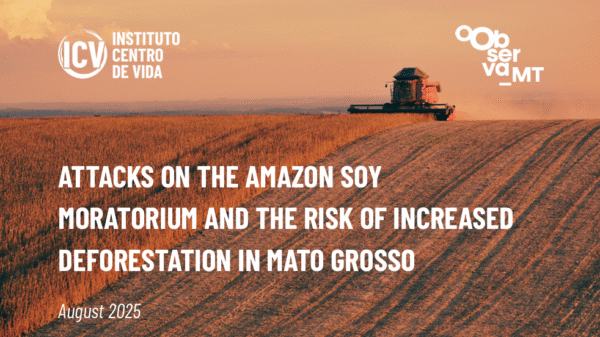
Mato Grosso is the largest soybean producer among Brazilian states, accounting for 28.7% of total grain production in 2023, with a production of 44 mi lion tons. Based on data from the United States Department of Agriculture and Embrapa, it is estimated that around 10% of the world’s soybean supply comes from Mato Grosso. The state was responsible for 30% of Brazil’s soybean exports, shipping more than 27 mi lion tons, according to data from the Foreign Trade Secretariat.
The total soybean cultivated area in Mato Grosso nearly doubled between 2008 and 2023, increasing from 5.8 mi lion to 10.5 mi lion hectares. Most of this area (97.5%) lies on land deforested before August 2008. In 2023, only 261,000 hectares of soybeans were cultivated in areas that had been cleared after this date. Despite the significant increase in soybean production, this did not result in substantial expansion into recently deforested areas.
Recognized as one of the main initiatives to combat deforestation in the soybean supply chain, the Soy Moratorium, created in 2006, contributed to this outcome. In this voluntary multi-stakeholder agreement, signatory companies committed not to purchase or finance soybeans grown on land in the Amazon that was deforested after July 22, 2008.
Despite its success and international recognition, the Soy Moratorium has recently been the target of criticism and attacks. Among them are legislative pressure and various attempts at regulatory
changes.
In this technical note, we provide a brief overview of the recent situation of the Soy Moratorium and the potential risks associated with the weakening of this initiative in Mato Grosso. Our analysis
shows that, for the state, eliminating the Soy Moratorium could lead to increased deforestation due to the expansion of soybean cultivation in the Amazon biome, whether directly or indirectly. We also emphasize that without the Soy Moratorium, the protection of native vegetation on rural properties would rely almost exclusively on the Forest Code, which sti l faces low levels of implementation.
© 2020 - Conteúdo sob licenciamento Creative Commons Atribuição 2.5 Brasil ICV - Instituto Centro de Vida | Política de Privacidade
Concepção e Design: Matiz Caboclo | Manutenção e atualização: Kasterweb